Don McCullin’s career as a photographer of conflict has covered much of the latter part of the 20th Century. He photographed his life in Finsbury Park in 1950s, construction of the Berlin Wall, wars in Cyprus, Biafra, Vietnam, Cambodia, Beirut, London Derry, and famine in Bangladesh.

All this photos, despite the desperate circumstances, are photographed with compassion, allowing us to glimpse the unbearable, documenting human conflict and its attendance grief.
Undeniably a brave man, wounded several times whilst photographing conflict,
McCullin, an artist at school, combines the elements in his photography with the eye of a painter. He has a trademark of darkness of printing and of black and white but he creates a mood,
Harold Evans describes ‘decisive moments’ which should be reserved for those few photographs that offer both a story and a picture, that provide a dramatic and a visual climax in the natural co-ordination of shapes, lines and values. McCullins’ photos have these desivive moments – a US army medic comforting a wounded two year old, the line of a Turkish boy’s arm and hand reaching up to his mother on news of his father’s death.
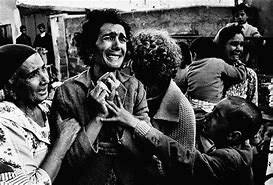
Luck may come into decisive moments. Coming on a father and two sons lying in their blood in a house in Cyprus, he writes, ‘I felt as if I had a canvas in front of me and I was, stroke by stroke, applying the composition to a story that was telling itself. I was, I realised later, trying to photography in a way that Goya painted or did his war sketches’
The shot of solders running along the Derry Road would have been dramatic on their own but with the woman at the doorway the shot is shocking.


McCullin’s photo of a shot Marine helped onto his feed by two friends, was McCullin said, resembled a painting of Christ being taken down from the cross.
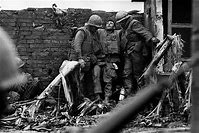
From his early photos of photographing people in Finsbury Park against their wallpaper – he does not invade privacy, they are not preyed upon, he involves them in his photos.. His subjects look into the lens – the man working in the iron foundry far from his native Bangladesh, the African father holding his starving child.
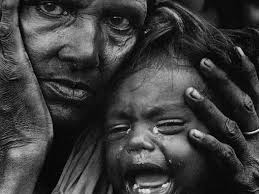
McCullins portraits have a deceptive simplicity. They are sympathetic but not sentimental. They do not make political points. They feel the subjects price, their sorrow and their terror.
Photography for me is not looking, it’s feeling. If you can’t feel what you’re looking at, then you’re never going to get others to feel anything when they look at your pictures
— Don McCullin

 The Bigger Picture